 GoyMail
Email · Email alias
GoyMail
Email · Email alias

YOPmail
Approvedyopmail.com
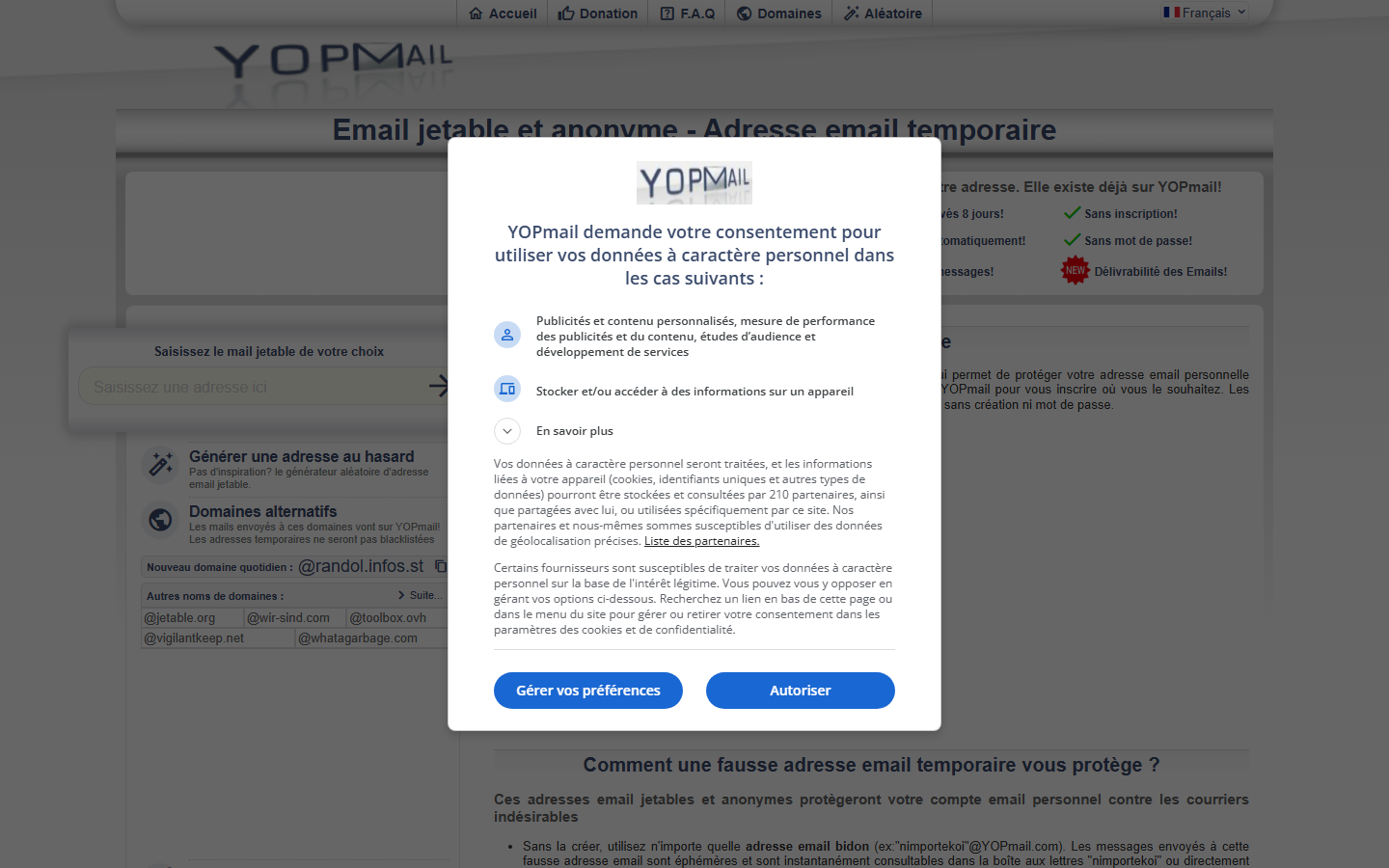
Veteran disposable / public-inbox email — type any name @yopmail.com, the inbox already exists. Zero signup, zero password, zero KYC. Messages are kept for 8 days. Receive-only: sending is limited to YOPmail-to-YOPmail (no outbound to real addresses). Dozens of alternate domains that auto-forward to the canonical YOPmail inbox, plus a per-inbox alias generator for extra obscurity. Critical caveat: inboxes are PUBLIC — anyone who types the same name reads the same mail. Useful for one-time signups, OTP receipt and spam isolation; not safe for anything you need to recover, secure or keep confidential.
Live preview
yopmail.com
▶
https://yopmail.com
Review
EditorialOverview
YOPmail is one of the oldest disposable inboxes on the public web — twenty-plus years of continuous operation, instantly recognisable to anyone who has ever needed to bypass a one-time newsletter signup, receive a verification code, or test a website’s email flow. The product is exactly what its homepage says it is, no more and no less: type any name @yopmail.com, the inbox already exists, the messages start arriving. There is no signup, no password, no email-on-file, no payment, no KYC. Messages are kept for 8 days. Dozens of alternate domains auto-forward to the canonical YOPmail inbox so a site that blocks yopmail.com can often still be fed via an alternate. A per-inbox alias generator adds an obscurity layer.
That description is also the source of YOPmail’s biggest single limitation, which any honest review has to lead with.
Privacy & KYC — read the two axes separately
YOPmail sits at KYC Tier L0 — Trustless. There is genuinely no identity surface: no signup, no password, no payment, no email-on-file, no phone-binding, no IP-against-identity link. The service does not know who you are because the service does not have a mechanism to ask. This is the directory’s strongest KYC tier and the reason YOPmail belongs here at all.
The confidentiality axis is the opposite picture. Because the inbox is addressable by name, with no password and no account boundary, the inbox is structurally public: anyone who types the same name reads the same mail. Two consequences fall out of this:
- OTPs work fine. A verification code that lives for 60 seconds and becomes worthless after use is a perfect fit for a public inbox — by the time anyone else guesses your address, the code is dead.
- Persistent secrets do not. A password-reset link that stays valid for 24 hours, a banking notification, a recovery code, anything containing personally identifying content — these all live in a publicly addressable inbox until either they expire or someone else opens them.
The privacy score of 55 / 100 reflects this honestly: excellent on KYC (true L0, structural), weak on confidentiality (public-by-design), limited on retention (8 days). It is not a typo that the score is moderate despite the L0 — privacy in this directory is not measured solely by KYC absence.
What it actually does well
For the use cases it is designed for, YOPmail is genuinely excellent:
- OTP and verification-code receipt for low-stakes signups — the dominant use case, and the one it does best
- Coupon-gate and download-gate bypass — sites that hold a download or a discount code behind an email opt-in
- Spam isolation — handing out a YOPmail address to a site you do not trust to respect your inbox
- Email flow testing — debugging your own site’s welcome-email, password-reset or transactional-email pipelines without polluting a real mailbox
- Short, multi-step onboarding flows where a verification email might arrive a few hours after signup — the 8-day retention window is the longest in the free disposable category and tolerates real-world delivery latency
The alias generator and the alternate-domain fleet between them also give YOPmail an unusually robust posture against disposable-domain blocklists: when a site rejects [email protected], switching to an alternate domain ([email protected] that auto-forwards to the same inbox) often gets the signup through. This is the structural reason YOPmail still works on a large fraction of the web despite being one of the oldest and most-detected disposable services in operation.
Sending — only YOPmail-to-YOPmail
YOPmail is receive-only for any practical real-world workflow. The homepage prohibits sending anonymous email to outside addresses. You can send YOPmail-to-YOPmail (useful for testing) but you cannot reply to a real address. If your workflow needs “click this link” messages, YOPmail covers it; if your workflow needs “reply with your details”, look at an email-alias service instead (browse the Email alias category in this directory).
Long-term use — what “long-term” actually means here
The popular framing that YOPmail can be used “long-term” is half-true and needs clarification. The inbox name persists indefinitely — you can come back to [email protected] months or years later and the inbox is still there for the typing. What does NOT persist is the mail itself: messages older than 8 days are deleted automatically. For a multi-step signup flow whose verification might lag by a few days, YOPmail is the right tool. For an account whose recovery email needs to remain valid for weeks, months or years, YOPmail is the wrong tool — look at an email-alias service for that workload.
Where YOPmail breaks — the site-block reality
YOPmail is on most disposable-domain blocklists, and major sites with serious fraud-prevention (banking, marketplaces, job boards, travel platforms, paid SaaS, government, healthcare) increasingly cross-reference signup emails against those lists. The headline is nuanced:
- The long tail of the web — newsletters, downloads, coupon gates, low-stakes consumer SaaS, content sites — typically still accepts YOPmail
- The fraud-aware tier — anything where the operator has a real cost-per-bad-signup — actively rejects YOPmail and its known alternates
- The alternate-domain rotation buys you some headroom but does not bypass an active anti-disposable signal at signup time
Plan accordingly: try the alternate-domain list first if the canonical yopmail.com is rejected; if both fail, the site is on the harder side of the detection spectrum and YOPmail is not the right tool.
Trust profile
YOPmail’s trust score of 72 / 100 is the highest in this directory’s disposable-email cluster and is genuinely earned: twenty-plus years of continuous operation, no documented scam history, extreme operational stability, and a clean reputation across two decades of user experience. Neo.space’s independent 2026 review rates YOPmail 4.4 / 5 as a disposable-email category leader. Anonibox’s 2026 analysis stops short of a numerical score but recommends YOPmail for exactly the use cases the directory rates it for — one-time activations, coupon gates, short free trials, spam control — and warns against it for exactly the use cases the directory penalises (anything with money, identity, healthcare, banking, recovery semantics).
Verdict
6.5 / 10. YOPmail is a true L0 disposable inbox with a 20-year operational record, a structural 8-day retention window that beats most competitors, a fleet of alternate domains and a per-inbox alias generator that together give it unusually durable real-world usefulness. The score sits at 6.5 / 10 rather than higher because of the structural public-inbox property: this is a great tool for OTP receipt, low-stakes signups and spam isolation, and an explicitly bad tool for anything you need to recover, secure or keep confidential.
Recommended use: verification codes for accounts you do not care about, gating downloads, hiding from newsletter senders, and testing your own email flows. For anything more, browse the Email alias category in this directory for recoverable-but-private aliasing, or the upper tier of Email for full privacy mailboxes (Tuta, Proton and similar).
Community summary
YOPmail is a veteran no-signup, no-password, no-KYC disposable inbox: type any name @yopmail.com and the inbox already exists. Messages are kept for 8 days, the canonical inbox is mirrored from dozens of alternate forwarding domains, and a per-inbox alias generator adds an obscurity layer. Receive-only — sending is limited to YOPmail-to-YOPmail. The dominant caveat is structural: inboxes are PUBLIC, so anyone who knows or guesses the address reads the same mail. Excellent for one-time signups, OTP receipt and spam isolation; structurally unsafe for accounts you need to recover, secure or keep confidential.
Pros
- + True L0 — no signup, no password, no KYC, no email-on-file, no payment, ever
- + Inbox exists the instant you type the name — zero provisioning step
- + 8-day message retention — longest among purely free disposable inbox services in 2026
- + Dozens of alternate domains, with new ones added regularly — auto-forward to the same canonical inbox
- + Per-inbox alias generator — adds an obscurity layer for users who need it
- + Free forever, no advertising on the inbox view itself
- + 9-language interface (English, French, Spanish, Italian, German, Polish, Russian, Ukrainian, Chinese)
- + Veteran service — 20+ years of continuous operation, extremely stable
- + Works perfectly for OTP / verification-code receipt on low-stakes signups
- + Operationally fast — messages typically appear within seconds of arrival
Cons
- − STRUCTURALLY PUBLIC INBOX — anyone who types the same name reads the same mail. There is no password, no isolation, no account boundary
- − Receive-only — sending is restricted to YOPmail-to-YOPmail; you cannot reply to real-world email addresses
- − Messages older than 8 days are deleted automatically — not a long-term archive
- − Increasingly blocked by major sites — banks, job boards, marketplaces, travel sites, security-sensitive software detect and reject yopmail.com and alternates
- − OTP timing failures are common — even small delivery delays burn time-limited codes
- − No password reset / recovery story — if a service ties account recovery to a YOPmail address, the account is functionally lost
- − Not safe for anything you may need to RECOVER, SECURE or keep PRIVATE — by design
- − IP logging is not explicitly addressed in published documentation
- − Company / jurisdiction not publicly disclosed
- − Clearnet only — no Tor / onion endpoint